Tampa, FL
Oven Repair in Tampa, FL
An oven that runs 40 degrees cool ruins food before anyone suspects the appliance. We repair electric and gas ovens, wall ovens and range ovens across Tampa.
- Phones answered, day and night
- Most repairs finished on the visit
- Major brands serviced
- Tampa based, not a call center
The Short Answer
An electric oven that will not heat is usually a failed bake or broil element, and a visible break or blister in the element confirms it. Off temperature baking is normally the oven sensor or a control board that needs recalibrating. On gas ovens the igniter is the most common failure, because a weak igniter no longer draws enough current to open the gas valve.
How an Oven Actually Controls Temperature
An oven is a loop. A sensor reads cavity temperature, the control compares it to what you set, and it switches the heat source on and off to hold the difference small. When baking goes wrong, the fault is in that loop.
No heat at all is the simplest case. On electric ovens the bake element usually fails visibly, with a break or a blistered section. On gas ovens the igniter weakens with age until it can no longer pull enough current to open the safety valve, so it glows without producing flame.
Off temperature is the harder complaint because the oven looks like it works. The usual causes are a drifting temperature sensor, a control that needs recalibration, or a door seal that lets heat escape faster than the oven can replace it.
What Oven Repair Costs in Tampa
Oven repairs range widely because a heating element and a control board are very different parts. These figures are Tampa planning ranges, not quotes.
Which part failed
Bake elements, igniters, sensors and thermostats commonly land between $165 and $375 with labor.
Electric or gas
Gas ovens need igniter and valve testing, which takes longer than swapping an element.
Range oven or wall oven
A wall oven has to be removed from cabinetry, which adds meaningful labor.
Control boards
Model specific, usually ordered, and the most expensive common part on an oven.
Age and part availability
Original built in ovens from the 1960s and 1970s often need sourced parts.
Double oven configuration
Shared boards and tighter access make these longer visits.
Figures on this page are general planning ranges for the Tampa area, not a quote. The machine, the part and how hard it is to reach all move the number.
Which Oven Faults You Can Handle Yourself
| Situation | Doing it yourself | Calling us |
|---|---|---|
| Oven runs cool | An oven thermometer is worth buying to confirm the drift yourself. | We measure with a calibrated probe and correct the calibration or replace the sensor. |
| Visible break in the element | Some owners replace a bake element themselves on a range. | We confirm the element is the only fault, since a shorted element sometimes takes a control with it. |
| Gas oven will not light | Leave it alone. | Igniter current draw gets measured, and the safety valve is tested before any part is fitted. |
| Door does not seal | Replacing a gasket is a reasonable owner job on many models. | We check the hinges and springs too, because a sagging door is usually the cause of a failed gasket. |
| Any wall oven repair | Not recommended. They are heavy and awkward to remove. | We pull and reset the unit safely and check whether parts are still available before you commit. |
What Testing Finds That Guessing Misses
Temperature gets measured, not assumed
A calibrated probe in the cavity settles whether the oven is actually off temperature.
The right heat part gets replaced
Bake, broil, convection and igniter faults look similar from the kitchen and are not.
Calibration gets corrected
Many ovens can be offset in the control, which fixes a drift without any part at all.
Gas components get tested safely
Igniter current draw is measured rather than eyeballed for glow.
You get the replace answer when it applies
A dead board on an old wall oven is often the end of the line, and we will say so.
Oven not holding temperature?
Before you replace the oven, let us test the element, the sensor and the control. Off temperature is usually a cheap part, not a dead appliance.
Why Wall Ovens Are a Different Job From Range Ovens
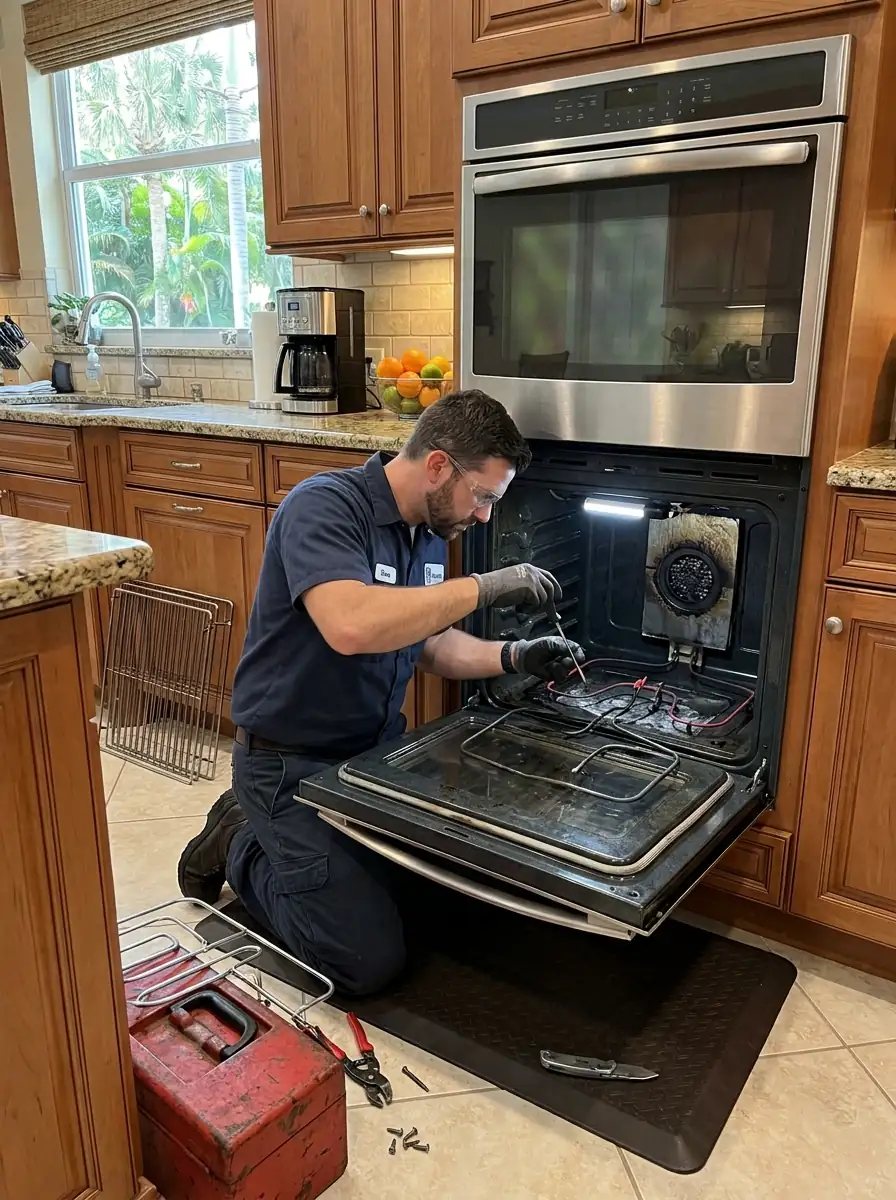
A range oven and a built in wall oven are the same appliance with very different service jobs. A range slides out. A wall oven is fitted into cabinetry, carries most of its weight over a cutout, and often needs two people and the cabinet trim removed before the back can be reached.
That matters in Tampa because of when the housing stock was built. In Terrace Park, Forest Hills, Carrollwood and Northdale, a lot of kitchens still carry the original built in wall oven and cooktop pair from the 1960s and 1970s. Those units are frequently out of production, so the question stops being can it be repaired and becomes can the part still be sourced.
Cabinet openings are the other complication. Older wall oven cutouts were not built to modern sizes, so when an old unit truly is finished, the replacement often needs cabinet modification. Knowing that early changes how people plan, which is why we say it at the diagnosis rather than later.
Double wall ovens add one more wrinkle. The two cavities usually share a control board, so a fault in one can be a shared component rather than two separate problems, and that is worth testing before anything is ordered.
What an Oven Repair Visit Covers
- Cavity temperature measured against the set point with a probe
- Bake and broil elements tested for continuity and inspected
- Convection element and fan checked where fitted
- Oven temperature sensor resistance tested
- Control board function and calibration offset checked
- Gas igniter current draw measured on gas models
- Gas safety valve operation verified
- Door hinges, springs and gasket checked for seal
- Interior wiring and terminal blocks inspected for heat damage
Signs Your Oven Is Failing
Baking times keep getting longer
The oven is running below its set temperature. The sensor or the calibration has drifted.
Food browns unevenly on one side
Either an element is partly failed or the convection fan has stopped moving air properly.
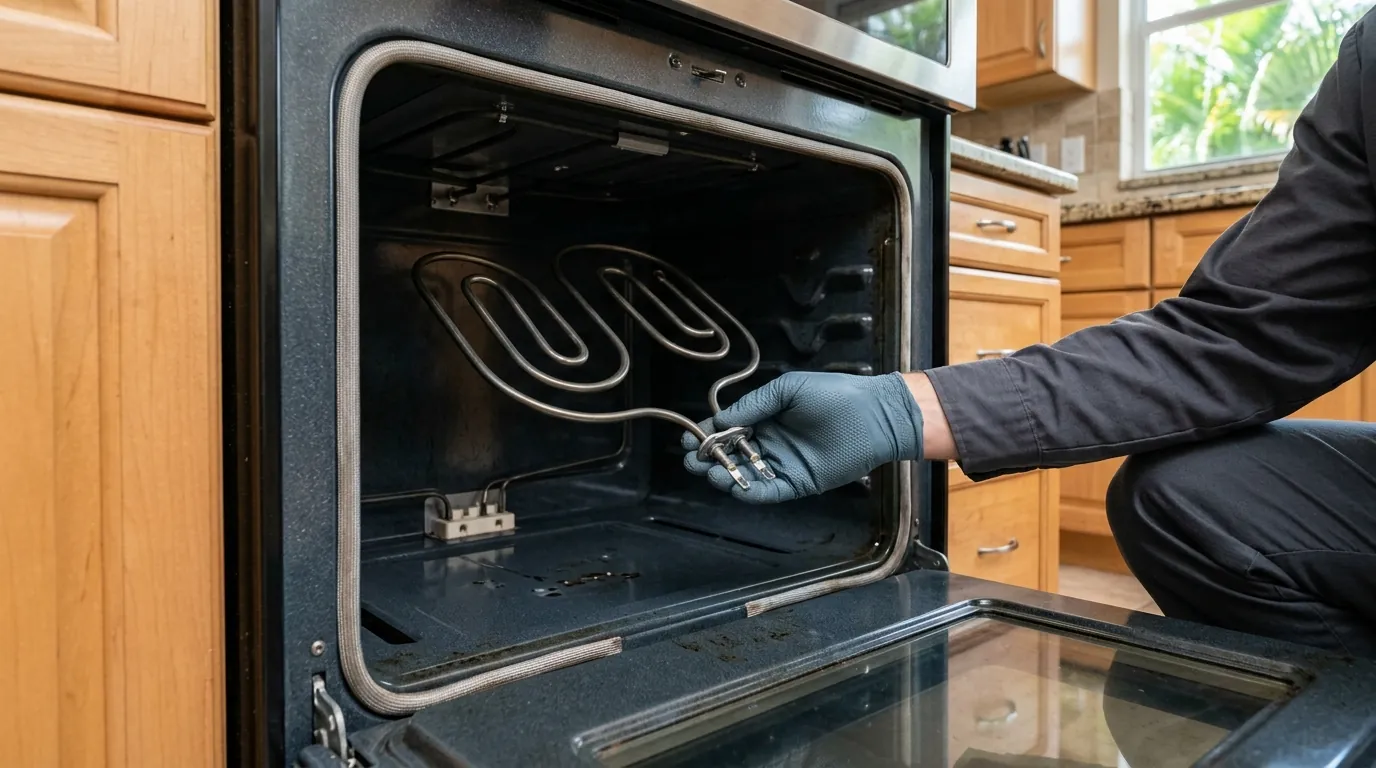
A visible break or blister on the element
That element has failed. It will usually still glow in places, which confuses people.
Gas oven clicks and glows but never lights
A weak igniter. It is still glowing, but not drawing enough current to open the valve.
The door will not close flush
A worn hinge or gasket. Heat escapes and the oven never settles at temperature.
What Happens After You Call About an Oven
Describe what the oven is doing
No heat, slow heat, uneven browning or an error code. Tell us electric or gas, range or wall oven.
We book the visit
Ovens are rarely an emergency, so we can usually give you a wider choice of window.
Diagnosis at the house
Cavity temperature first, then elements, sensor and control in sequence.
You get the cost and the availability
Including whether the part is still made, which matters on older built in units.
The repair
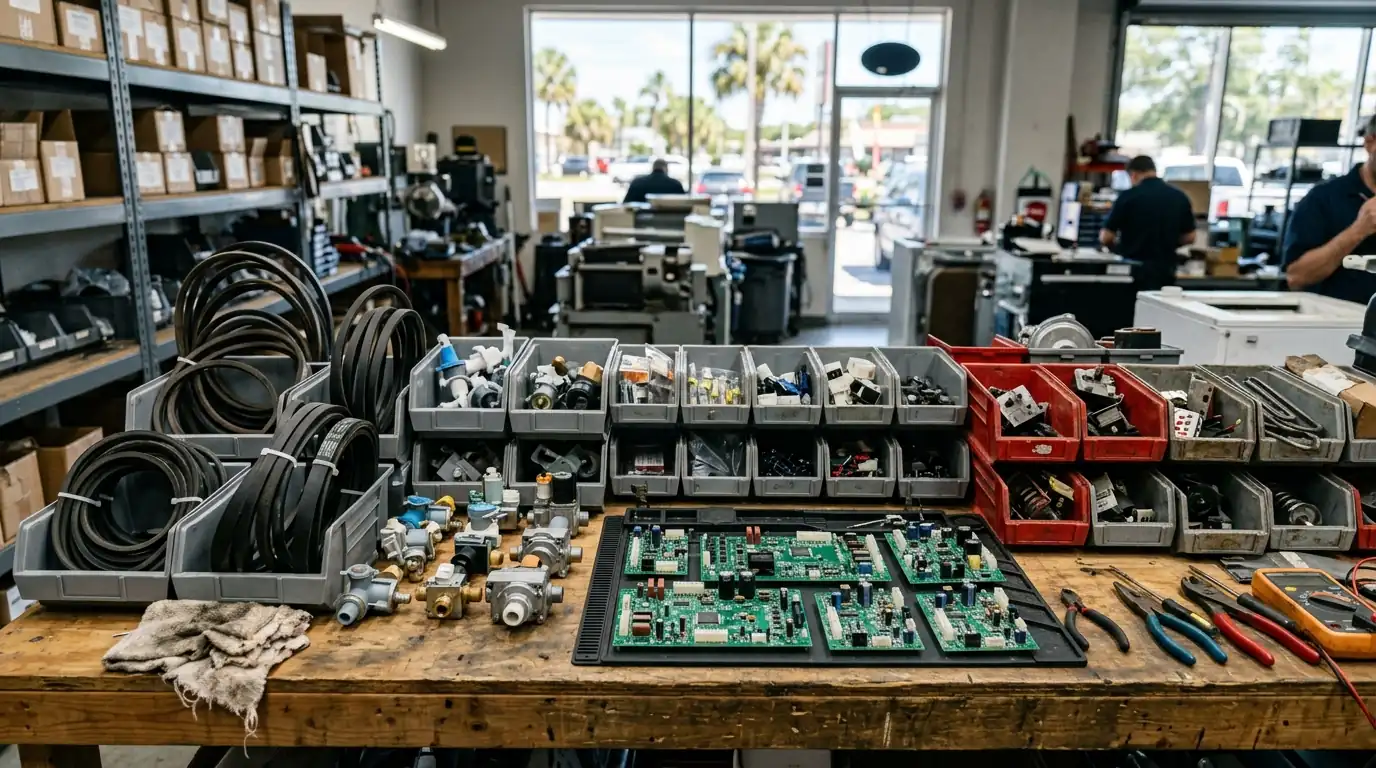
Elements, sensors and igniters for common brands are carried on the van.
How Long an Oven Repair Takes
A range oven repair is usually one visit of about an hour to ninety minutes. Elements, sensors and igniters are all straightforward once the diagnosis is made.
Wall ovens take longer, often two hours or more, because the unit has to come out of the cabinet and go back in cleanly.
Control boards and older model specific parts need ordering. On units past about twenty years, part availability rather than labor is what decides the timeline.
Oven Work in Tampa Homes and Older Kitchens
The mid century neighborhoods carry the hardest oven work. In Terrace Park, Forest Hills, Carrollwood Village and Northdale, original wall oven and cooktop pairs are still in service, and when one fails the other is often close behind.
In the newer subdivisions of Westchase, New Tampa, Lithia and Riverview, ovens are usually part of a matched suite under ten years old, where boards and sensors are the common faults and parts are readily available.
Downtown and in the Hyde Park remodels, wall ovens are frequently built into custom cabinetry, so removal has to be done carefully to avoid damaging trim that cannot easily be matched.
ZIP codes we cover for this repair
These are the areas this service runs into most, with the ZIP each one falls under.
- Downtown Tampa (33602)
- Channel District (33602)
- Ybor City (33605)
- Tampa Heights (33602)
- Seminole Heights (33603)
- Riverside Heights (33603)
- Wellswood (33603)
- Sulphur Springs (33604)
- St. Petersburg (33701)
- Brandon (33511)
- Clearwater (33755)
- Riverview (33578)
- Largo (33770)
- Wesley Chapel (33544)
- Pinellas Park (33781)
- Plant City (33563)
Why This Repair Goes Better With Us
Temperature gets measured
A probe in the cavity is the only honest way to confirm an oven is running cool.
Wall ovens are normal work for us
Removing and resetting a built in unit safely is part of the job, not an obstacle.
We check part availability first
On an older built in oven, that question decides everything else.
Oven Questions We Get Asked
It is running below its set temperature. The usual causes are a drifting temperature sensor, a calibration offset that needs correcting, or a partly failed bake element. A probe in the cavity settles which one.
On a range it is within reach for a confident owner, with the power off at the breaker. The reason to have it tested first is that a shorted element sometimes damages the control, and replacing the element alone would leave you back where you started.
The igniter has weakened. It still glows, but it no longer draws enough current to open the gas safety valve. That is the most common gas oven failure and it is a standard repair.
It depends entirely on whether the part is still available. When it is, repair is usually the better value, because replacing a built in oven often means cabinet modification too. We check availability before you decide.
Either one heat source is partly failed, the convection fan is not circulating, or the door seal is letting heat escape. All three are checked on a visit.
Elements, sensors, thermostats and igniters commonly land between $165 and $375 with parts and labor. Control boards run higher. These are planning ranges rather than quotes.
Yes. They often share a control board between cavities, so we test that before assuming there are two separate faults.
More common than people expect. Self clean runs the cavity extremely hot, and that heat is hard on thermal fuses, door locks and control boards. It is a frequent reason for a call the day after cleaning.
Repairs That Pair With This One
Get the oven back to temperature
Tell us whether it makes no heat or the wrong heat. Those two answers lead to completely different parts.