Tampa, FL
Gas Appliance Repair in Tampa, FL
Gas appliances fail at the ignition chain, and that chain is not a place to guess. We repair gas ranges, ovens, dryers and water heaters across Tampa.
- Phones answered, day and night
- Most repairs finished on the visit
- Major brands serviced
- Tampa based, not a call center
The Short Answer
Gas appliance repair in Tampa centers on the ignition chain: an igniter that draws enough current, a sensor that confirms flame, and a valve that opens only when both are satisfied. When an appliance glows but never lights, the igniter has usually weakened rather than failed outright, and current draw is what proves it.
How a Gas Appliance Decides It Is Safe to Light
Every gas appliance runs the same basic safety logic. Something creates ignition, something confirms that ignition actually happened, and only then does the valve keep gas flowing. If confirmation never arrives, the valve shuts, which is exactly what it should do.
That is why the most common gas complaint is an appliance that tries and gives up. A range burner that clicks without catching, an oven that glows without lighting, a dryer that runs cold, a water heater whose pilot will not stay lit. Each is the safety chain refusing to complete.
The diagnosis is electrical rather than mechanical. Igniter current draw, flame sensor response and valve operation all measure cleanly, so the failed link can be identified rather than guessed at by replacing parts in order of price.
Signs a Gas Appliance Needs Attention
A burner clicks but will not catch
Fouled electrodes or a failed spark module on the cooktop side.
An oven igniter glows but no flame appears
The classic weakened igniter. It still glows but no longer draws enough current.
A gas dryer runs without heat
Igniter, flame sensor or valve coils, and each tests separately.
A water heater pilot that will not stay lit
The thermocouple is failing to confirm the flame.
A yellow or lazy flame
Blocked ports or an incorrect air mix, and it burns dirtier while it does it.
What Happens After You Call About Gas
Tell us the appliance and the symptom
And say immediately if there is any smell of gas.
Safety first on the call
If gas is present we tell you what to do before anything else is discussed.
We book the visit
Gas faults are treated as urgent regardless of how minor they look.
Diagnosis at the appliance
Igniter draw, sensor response and valve operation measured in order.
The repair
Igniters, thermocouples and sensors for common appliances ride with us.
Smell gas at an appliance?
Do not operate it and do not use switches. Ventilate the room, and if the smell is strong leave and call the gas utility before you call us.
Why Igniters Fail Gradually Rather Than Suddenly
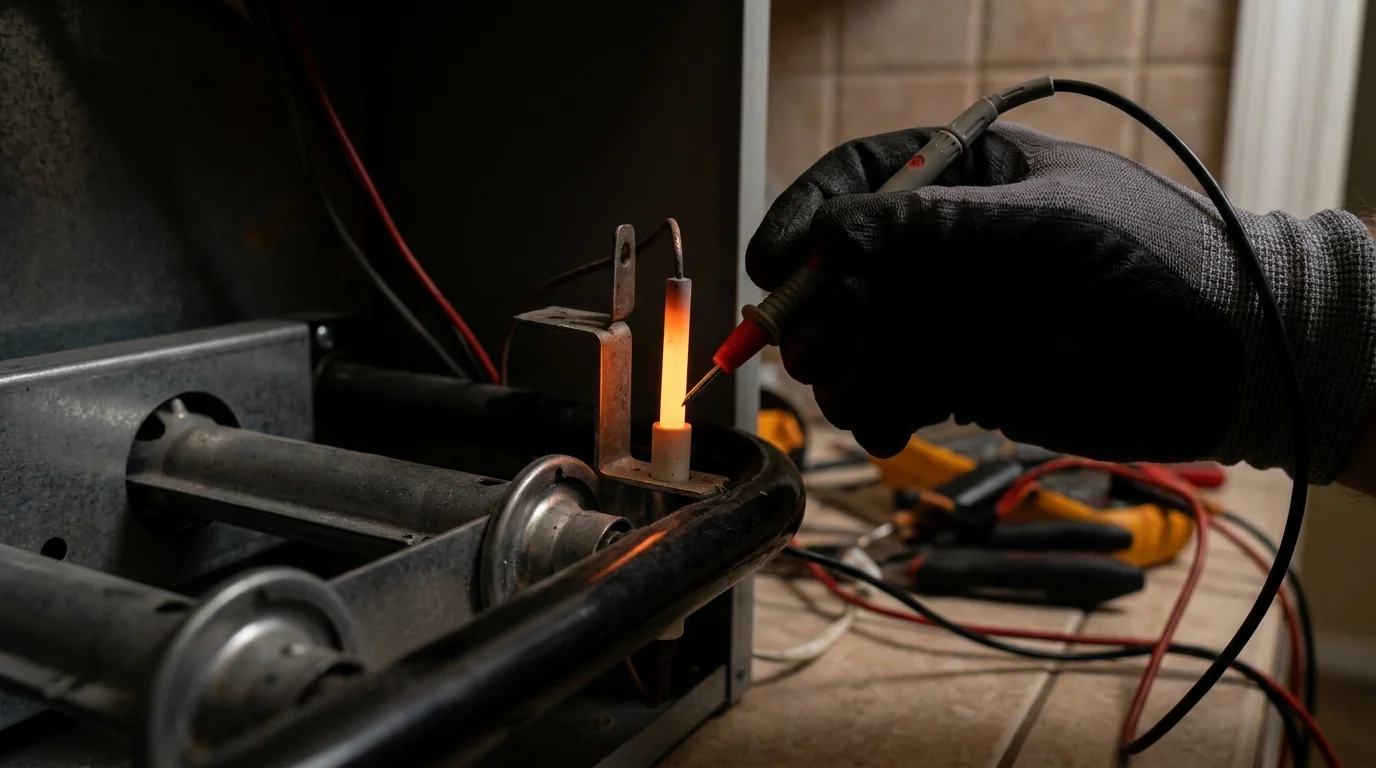
Hot surface igniters are the reason so many gas appliance faults look confusing. The igniter is a ceramic element that glows when current passes through it, and the control uses that current draw as its signal that the igniter is hot enough to light gas safely.
As the element ages its resistance rises, so it draws less current. It still glows, sometimes brightly, but the control never sees the threshold it needs and the valve never opens. Owners quite reasonably conclude that the igniter works, because they can see it glowing, and the fault gets blamed on the valve or the board.
Measuring current draw settles it in a minute. A healthy igniter pulls within a specified range, and a weak one sits below it while looking identical. This is the single most common gas oven and gas dryer fault we see, and it is a straightforward part to replace.
Gas is less common in Tampa homes than in colder markets, which cuts both ways. Where it exists, it tends to be in the older neighborhoods with gas ranges, in newer builds with gas ranges and dryers, and in water heaters throughout. Because it is less common, gas appliances here often go longer between service visits than they should.
What a Gas Appliance Visit Covers
- Gas supply and appliance shutoff located and verified
- Igniter current draw measured against the specification
- Flame sensor or thermocouple response tested
- Gas valve coils tested for operation
- Spark module and electrodes checked on cooktop burners
- Burner ports inspected and cleared
- Flame quality and color assessed
- Appliance gas connection inspected for integrity
- Ventilation and exhaust path checked where the appliance requires it
What Proper Gas Testing Involves
Current draw gets measured
Which is the only way to identify an igniter that is weak rather than dead.
The safety chain is tested in order
Igniter, sensor, then valve, so the actual failed link is found.
Gas connections get checked
As part of the visit rather than as an extra.
Combustion quality gets looked at
Flame color and burner port condition, not just whether it lights.
Dangerous situations get named plainly
If something should not be used until it is fixed, you hear that clearly.
How Long a Gas Repair Takes
Most gas repairs take one to two hours in a single visit. Igniters, thermocouples and flame sensors are all in that group.
Gas valves and model specific controls usually need ordering, which makes those two visits.
Diagnosis takes longer than the electric equivalent, because each link in the safety chain gets measured rather than assumed.
What You Should Never Attempt With Gas
| Situation | Doing it yourself | Calling us |
|---|---|---|
| Burner will not light | Cleaning the cap and electrode with the gas off is reasonable. | We test the spark module, which affects every burner when it fails. |
| Oven glows but no flame | Nothing at home. | Igniter current draw measured, which is the only way to identify a weak one. |
| Pilot will not stay lit | Relighting once per the appliance label is fine. | The thermocouple gets tested rather than the pilot relit repeatedly. |
| Gas dryer with no heat | Nothing at home. | Igniter, flame sensor and valve coils tested in sequence. |
| Any gas smell | Do not operate anything, ventilate, and call the utility if it is strong. | We test the appliance side once the situation is safe. |
What Gas Appliance Repair Costs in Tampa
Gas repairs take longer to diagnose than electric equivalents because the safety chain has more links. These are Tampa planning ranges, not quotes.
Which link failed
Igniters, thermocouples and flame sensors commonly land between $175 and $365 with labor.
Gas valve replacement
The most expensive common gas part, and always priced against appliance age.
Appliance type
A gas water heater, a gas range and a gas dryer each carry different access and diagnosis time.
Spark module on a cooktop
A shared component, so one failure can affect every burner.
Access to the connection
A range that has to come out or a water heater in a tight closet takes longer.
Whether ventilation work is needed
Exhaust and venting issues on gas appliances are separate from the ignition fault.
Figures on this page are general planning ranges for the Tampa area, not a quote. The machine, the part and how hard it is to reach all move the number.
Gas Appliances Across Tampa Homes
Gas ranges are common in the older Tampa neighborhoods, including Ybor City, West Tampa, Seminole Heights and Belmont Heights, where they have often been in service for decades.
In the newer builds across Westchase, New Tampa, Lithia and parts of Riverview, gas ranges and gas dryers appear together, and igniter faults on both turn up at similar ages.
Gas water heaters are spread throughout the metro, frequently in garages and exterior closets, and the thermocouple is the part that brings us out most often.
ZIP codes we cover for this repair
These are the areas this service runs into most, with the ZIP each one falls under.
- Downtown Tampa (33602)
- Channel District (33602)
- Ybor City (33605)
- Tampa Heights (33602)
- Seminole Heights (33603)
- Riverside Heights (33603)
- Wellswood (33603)
- Sulphur Springs (33604)
- St. Petersburg (33701)
- Brandon (33511)
- Clearwater (33755)
- Riverview (33578)
- Largo (33770)
- Wesley Chapel (33544)
- Pinellas Park (33781)
- Plant City (33563)
Why This Work Needs Testing, Not Swapping
Current draw gets measured
A glowing igniter is not proof of a working igniter, and only a meter shows the difference.
The safety chain is tested in order
Rather than replacing the most expensive part and hoping.
Connections get checked
As routine, not as an upsell.
Gas Appliance Questions We Get Asked
The igniter has weakened. As it ages its resistance rises and it draws less current, and the control uses that current as its signal to open the gas valve. It still glows, which is why the fault is so often misread.
If there is any smell of gas, no. Stop using it, ventilate, and call the gas utility if the smell is strong. For ignition faults with no smell, the safety systems are generally doing their job by refusing to light, but it still needs looking at.
A small sensor that confirms the pilot flame is lit. When it fails, the gas valve shuts down as a safety measure. It is the most common gas water heater fault and a routine repair.
Blocked burner ports or an incorrect air mix. A yellow flame burns dirtier, leaves residue on cookware and is worth correcting rather than living with.
Yes, and gas water heaters too. The ignition logic is similar across all three, which is why they sit together as one service.
Igniters, thermocouples and flame sensors commonly land between $175 and $365 with parts and labor. Gas valves run higher. These are planning ranges rather than quotes.
We check the appliance connection as part of every visit. Work on the house gas supply beyond the appliance connection is a separate trade, and we will tell you clearly when that is what is needed.
Often yes. Older gas ranges are mechanically simple, and the limiting factor is usually whether the specific part is still available rather than the age of the appliance.
Repairs That Pair With This One
Get the gas appliance tested properly
Tell us the appliance and exactly what it does when you try to use it. And mention any smell of gas straight away.