Tampa, FL
Ice Machine Repair in Tampa, FL
An ice machine in a Tampa summer is running at its limit already. We service undercounter and modular ice machines for bars, cafes, offices and homes.
- Phones answered, day and night
- Most repairs finished on the visit
- Major brands serviced
- Tampa based, not a call center
The Short Answer
Ice machine faults in Tampa come down to water quality, heat and the harvest cycle. Scale on the evaporator plate slows freezing and stops cubes releasing cleanly. High ambient temperature in a hot kitchen cuts production further. A machine that freezes but never harvests usually has a scale problem or a failed harvest component rather than a refrigeration fault.
How an Ice Machine Makes and Releases Ice
An ice machine runs two alternating phases. In the freeze phase water flows over a chilled evaporator plate and ice builds up on it. In the harvest phase the plate is warmed slightly so the ice releases and drops into the bin.
Almost every production complaint traces to one of those two phases. Slow or partial freezing usually means scale insulating the plate, restricted water flow or a machine fighting high ambient heat. Ice that forms but will not release means the harvest phase is not completing.
That split makes the diagnosis efficient. Watching one full cycle tells you which phase is failing, and from there the component list is short.
What Ice Machine Service Costs in Tampa
Ice machine work is mostly service rather than parts, which keeps it predictable. These are Tampa planning ranges, not quotes.
Descale and full service
The core visit, generally between $215 and $395 depending on machine size and condition.
Harvest component repair
Priced with the part once the failing component is identified.
Water filtration
Fitting or upgrading filtration adds to the visit and pays for itself in this area.
Machine type and size
Undercounter units are quicker than modular head and bin combinations.
Condition on arrival
A machine several years past its last service takes considerably longer.
Service interval
A scheduled interval costs less overall than a rescue visit before a busy weekend.
Figures on this page are general planning ranges for the Tampa area, not a quote. The machine, the part and how hard it is to reach all move the number.
What Your Staff Can Do Between Visits
| Situation | Doing it yourself | Calling us |
|---|---|---|
| Output dropping | Note the daily shortfall. | We descale and time a full cycle to confirm production has come back. |
| Cloudy or small cubes | Change the water filter. | We clear the water distributor and descale the plate. |
| Ice not releasing | Nothing at home. | We watch the harvest phase and test the components that drive it. |
| Bin hygiene | Staff cleaning of the bin between services is worth doing. | We sanitise the full water path, which staff cannot reach. |
| Water around the unit | Check the drain is not blocked at the floor. | We check the drain path and the water system for leaks. |
What a Proper Service Restores
Output actually comes back
Descaling restores heat transfer, which is what production depends on.
The failing phase gets identified
Freeze or harvest, which narrows everything that follows.
Water quality gets addressed
Filtration is usually the cheapest long term fix in this area.
Hygiene gets handled
Bin and water path cleaning is part of the service, not an extra.
Ambient limits get explained
A machine in a hot kitchen has a ceiling, and knowing it prevents chasing a phantom fault.
Production falling short of the day?
Ice machines lose output gradually, so it is easy to miss until a busy day. Call before the weekend rather than during it.
Scale, Heat and Tampa Summer Production
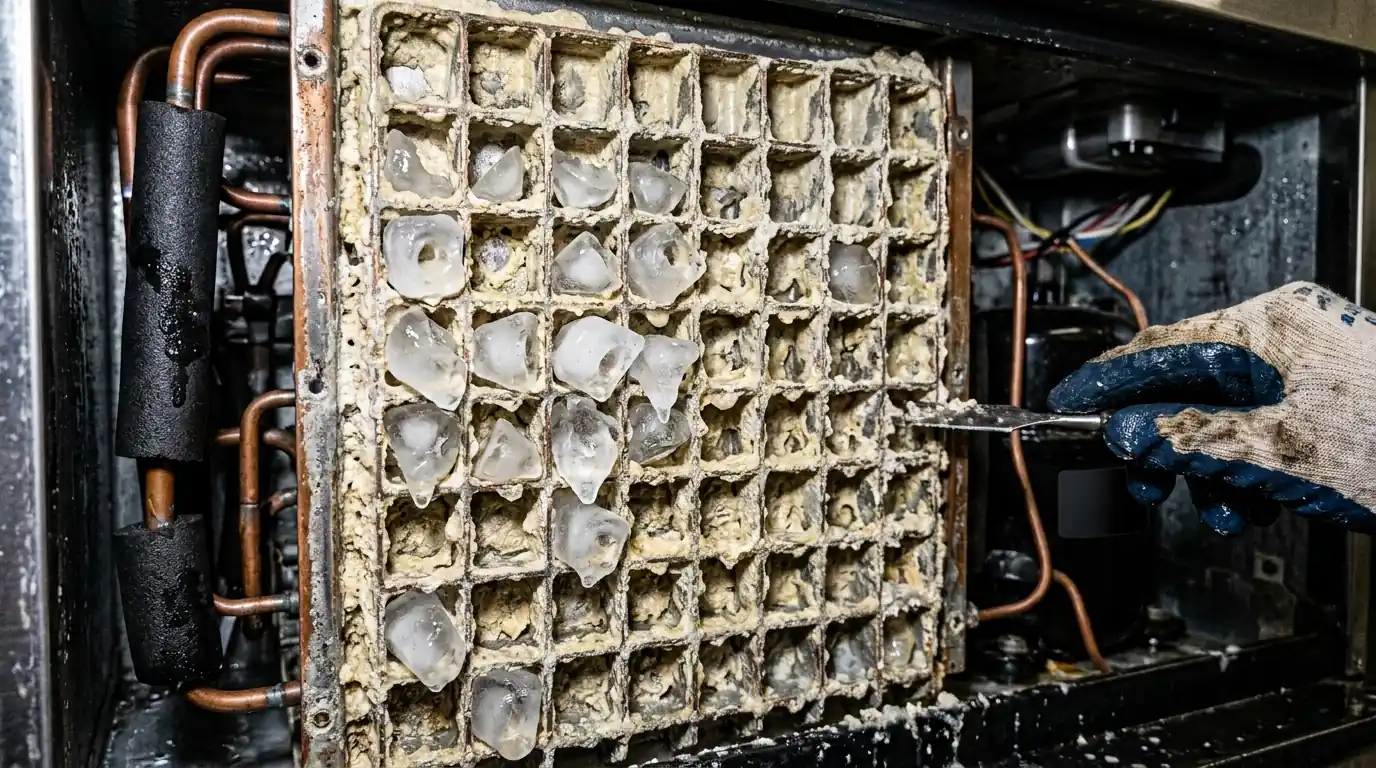
Ice machines are the appliance most punished by hard water, because they evaporate and refreeze water continuously. Every cycle leaves minerals behind on the evaporator plate, and that layer insulates the plate from the water flowing over it.
The effect is gradual and it is why owners rarely notice. Freeze time lengthens by a little each month, output drops a little each month, and one busy Saturday the machine runs out. Nothing broke, it just quietly lost a third of its capacity over a year.
Heat is the second half. Ice machines are rated at a specific ambient temperature, and production falls as the room gets hotter. A machine in a Tampa kitchen in August, especially one tucked under a counter with restricted airflow, is producing well under its rated figure before any fault exists.
That combination is why we treat descaling and airflow as the core of the service rather than as maintenance extras. A machine that has been descaled, has clean condenser airflow and has decent filtration will usually return to something close to its rated output without a single component replaced.
What an Ice Machine Service Covers
- One full freeze and harvest cycle observed and timed
- Evaporator plate inspected and descaled
- Water distributor and flow across the plate checked
- Water filter condition and supply pressure checked
- Harvest components tested where release is failing
- Condenser coils cleaned and airflow clearance checked
- Ambient temperature recorded and production expectation set
- Drain path cleared and checked for backflow
- Bin, water path and food contact surfaces sanitised
Signs an Ice Machine Is Losing Output
Daily output no longer covers a busy day
Production has drifted down gradually, usually from scale.
Cubes are cloudy, small or misshapen
Water flow across the plate is uneven, typically scale or a blocked distributor.
Ice sticking to the plate instead of dropping
The harvest phase is not completing properly.
The machine runs continuously without filling the bin
It is freezing and harvesting inefficiently, and running costs are climbing with it.
Water pooling around the unit
A drain restriction or a leak in the water system.
What Happens on an Ice Machine Visit
Tell us the machine and the shortfall
Type, roughly how old, and how far output has fallen.
We schedule around trading
Before opening or after closing where the machine sits in a working kitchen.
A full cycle gets observed
Freeze and harvest timed, which identifies the failing phase.
Descale and clean
Evaporator plate, water path, condenser and bin.
Component work where needed
Once the failing phase is confirmed rather than guessed.
How Long an Ice Machine Service Takes
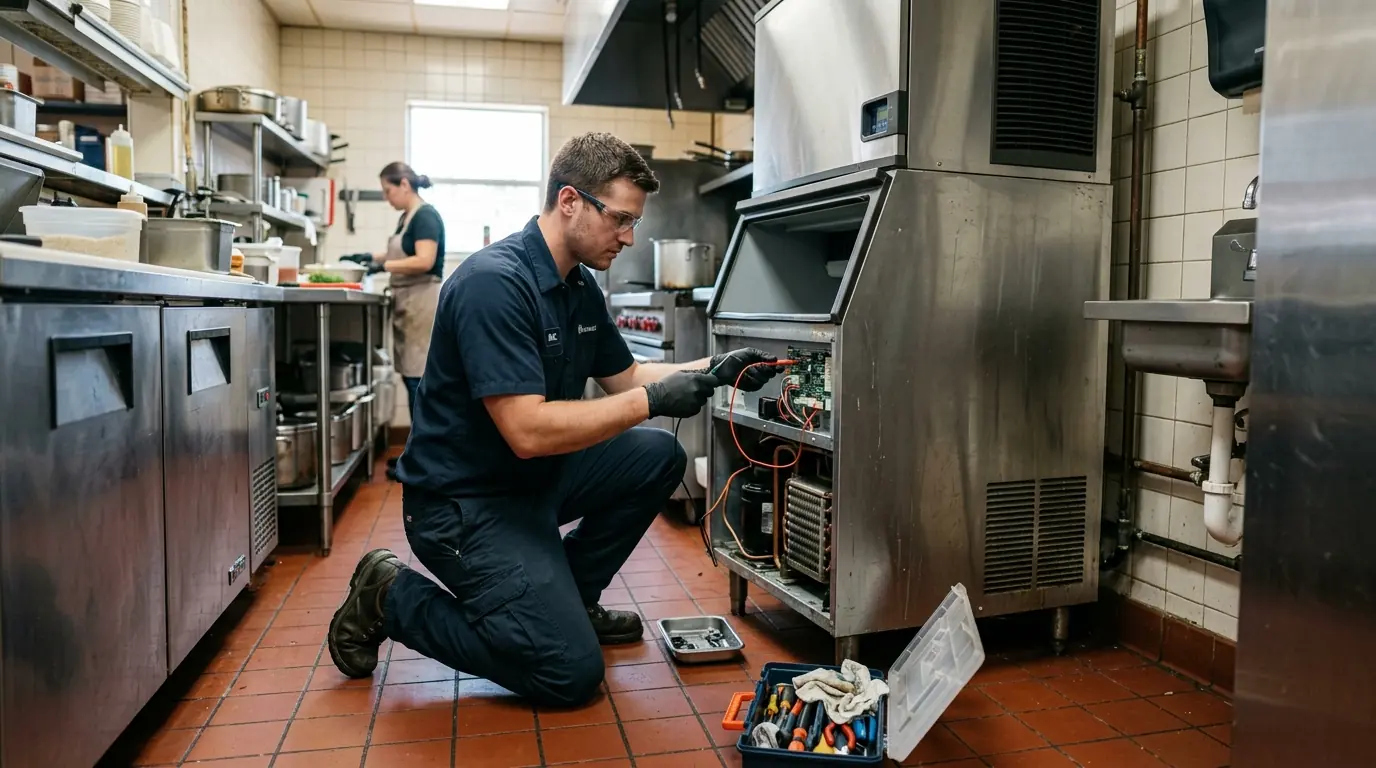
A full descale and service takes about two to three hours depending on machine size and how long it has been since the last one.
Harvest component repairs add time, and commercial specific parts may need ordering.
Production then takes a few hours to build back up, so we confirm cycle times rather than waiting for a full bin.
Ice Machines Across Tampa Businesses
Bars, cafes and restaurants along Seventh Avenue in Ybor City, South Howard Avenue and across the downtown and Channel District blocks run ice machines hardest, particularly through summer.
Offices and break rooms across the Westshore business district and the Brandon commercial corridor run smaller undercounter units that still scale at the same rate.
Residential undercounter ice makers in the newer kitchens of Westchase, New Tampa and Lithia face the same water and heat conditions on a smaller scale.
ZIP codes we cover for this repair
These are the areas this service runs into most, with the ZIP each one falls under.
- Downtown Tampa (33602)
- Channel District (33602)
- Ybor City (33605)
- Tampa Heights (33602)
- Seminole Heights (33603)
- Riverside Heights (33603)
- Wellswood (33603)
- Sulphur Springs (33604)
- St. Petersburg (33701)
- Brandon (33511)
- Clearwater (33755)
- Riverview (33578)
- Largo (33770)
- Wesley Chapel (33544)
- Pinellas Park (33781)
- Plant City (33563)
Why Descaling Is Most of the Job
Descaling is treated as the main event
Because in this water it usually is.
A full cycle gets watched
Freeze and harvest timed, rather than a quick look at the bin.
Airflow gets checked
An undercounter machine with restricted clearance cannot reach its rating.
Ice Machine Questions We Get Asked
Often not. Scale on the evaporator plate insulates it and lengthens freeze times gradually, so output falls slowly over months. A proper descale usually restores most of it without any part being replaced.
The harvest phase is not completing. Scale is the most common cause, and a failed harvest component is next. Watching a full cycle identifies which.
In this area, roughly every six months for a commercial machine in regular use, and at least annually for a lighter duty or residential unit. Hard water makes the interval shorter here than the manual suggests.
Yes, significantly. Machines are rated at a specific ambient temperature, and a hot Tampa kitchen in August pushes production well below the rated figure before any fault exists.
In this water, yes. It slows scale accumulation, which is the main thing limiting output, and it is usually the cheapest reliability investment available for one of these machines.
A full descale and service generally lands between $215 and $395 depending on size and condition. Component repairs are priced with the part. These are planning ranges rather than quotes.
Yes. They face the same water and heat conditions, just at smaller scale, and they scale up the same way.
Yes, and for a business it is worth it. A scheduled descale costs far less than running short of ice on the busiest day of the week.
Repairs That Pair With This One
Get production back up
Tell us the machine type and roughly how far output has dropped. Most of the time this is a descale rather than a repair.