Tampa, FL
Built In Refrigerator Repair in Tampa, FL
A built in refrigerator is a refrigeration repair inside a cabinetry problem. We service panel ready and column units across Tampa without damaging the surround.
- Phones answered, day and night
- Most repairs finished on the visit
- Major brands serviced
- Tampa based, not a call center
The Short Answer
Built in refrigerator faults in Tampa usually start with ventilation. These units vent through a grille rather than open air behind them, so a dust loaded condenser or a blocked grille makes the unit run warm long before any component has failed. Beyond that they fail like any refrigerator, with fans, defrost circuits and seals leading the list.
Why Built In Units Are a Different Service Job
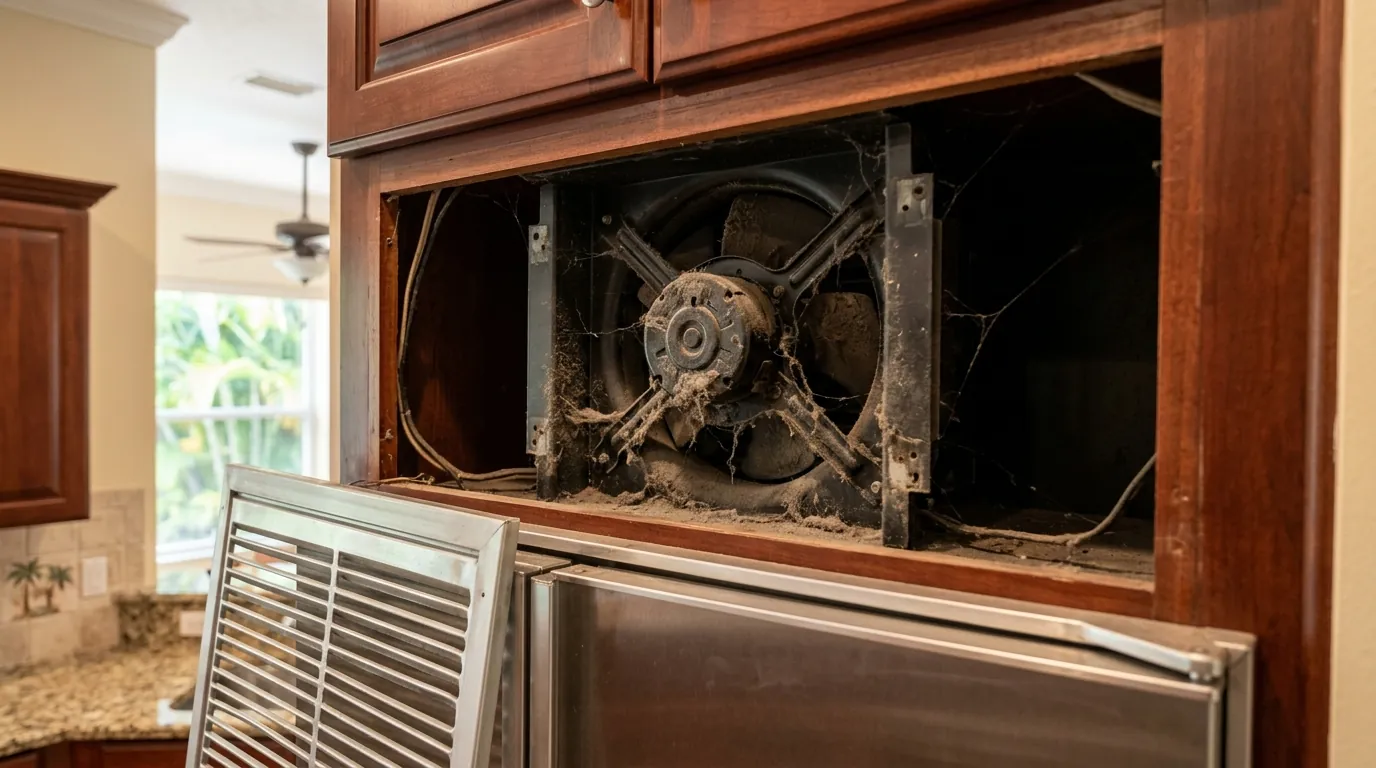
A built in refrigerator sits flush inside cabinetry, which means it cannot reject heat out of the back the way a freestanding unit does. Instead it vents through a grille, usually at the top or the base, and that grille is the unit's entire connection to the room.
That single design difference explains most built in complaints. A grille blocked by cabinetry trim, a condenser packed with dust, or a condenser fan that has failed will all produce a cabinet that runs warm, and none of them are refrigeration faults in the usual sense.
Past ventilation, they fail like any refrigerator: evaporator fans, defrost circuits, thermistors, door seals and eventually the sealed system. The parts are more often model specific and the access takes longer, but the diagnosis follows the same logic.
What Built In Refrigerator Repair Costs in Tampa
Built in repairs cost more in labor and parts than freestanding ones, and the replacement alternative costs far more again. These are Tampa planning ranges, not quotes.
Which part failed
Fans, thermistors, defrost parts and seals commonly land between $245 and $525 with labor.
Access and cabinetry
Trim removal and refitting is part of every visit and adds to the labor.
Model specific parts
Built in units use fewer shared components, so parts cost more and often need ordering.
Sealed system work
The expensive repair, but still frequently worth it given the replacement alternative.
Door and hinge adjustment
Often a modest job on its own and worth doing before a seal fails.
Column configurations
Separate refrigerator and freezer columns are two units and are priced accordingly.
Figures on this page are general planning ranges for the Tampa area, not a quote. The machine, the part and how hard it is to reach all move the number.
What Owners Can Safely Do
| Situation | Doing it yourself | Calling us |
|---|---|---|
| Unit running warm | Check nothing is blocking the grille. | We clean the condenser through the service access, which owners cannot reach. |
| Condensation at the door | Wipe and check the door closes flush. | We adjust the hinge and seal, which on a heavy panel door needs setting properly. |
| Ice in the freezer column | Nothing at home. | We test the defrost circuit the same as any refrigerator. |
| Water in the cabinet base | Stop and call, since it reaches cabinetry. | We clear the defrost drain and check the pan. |
| Removing the unit | Do not attempt it. | These are heavy, fitted and connected, and removal is part of the service where needed. |
What Careful Access Protects
Ventilation gets ruled out first
It is the most common cause and the cheapest to correct.
The cabinetry survives the visit
Trim and panels come off and go back without marking.
Heavy doors get adjusted properly
Panel ready doors carry real weight and need setting rather than forcing.
Model specific parts get identified early
Availability matters more on these units than on freestanding ones.
You get a real repair or replace read
Replacing a built in is a cabinetry project, which changes the maths.
Built in unit drifting warm?
These units almost always have a ventilation or condenser problem before they have a compressor problem. Call before assuming the worst.
Ventilation, Cabinetry and Panel Ready Doors
The economics of a built in unit are different, and it is worth being explicit about it. A freestanding refrigerator with a failed sealed system is usually a replacement decision. A built in unit fitted into custom cabinetry is not, because replacing it means finding a unit that matches the opening, and often means cabinetry work as well.
That pushes the repair threshold much higher. Repairs that would not be worth doing on a freestanding fridge frequently are worth doing on a built in one, purely because the alternative is so much more disruptive.
Panel ready doors add weight that the hinges have to carry for years. A custom wood panel is heavy, and over time the door drops slightly, which stops the gasket sealing evenly along the top. In Tampa humidity an imperfect seal shows up quickly as condensation and as a unit that never stops running.
Ventilation clearance is the other cabinetry issue, and it is usually created at installation. If the grille was partly covered by trim during a kitchen fit, the unit has been running warm since the first day and no component replacement will change that. We check it before we check anything else.
What a Built In Refrigerator Visit Covers
- Cabinet temperatures verified in each compartment with a probe
- Ventilation grille clearance checked against the maker's requirement
- Condenser inspected and cleaned through the service access
- Condenser and evaporator fans tested
- Defrost heater, thermostat and control circuit tested
- Defrost drain cleared and flow into the pan confirmed
- Door seals checked along their full length for even compression
- Panel ready door weight and hinge adjustment checked
- Water and ice systems checked where fitted
Signs a Built In Refrigerator Is Struggling
The unit runs constantly and still drifts warm
Ventilation first. The grille and the condenser are where to look.
The kitchen cabinetry near the unit feels warm
Heat is not escaping through the grille as intended.
Condensation around the door frame
A seal or hinge alignment issue, made worse by Tampa humidity.
Ice building on the freezer column walls
Defrost circuit, the same as any refrigerator.
The heavy panel ready door has dropped
Hinge adjustment. Left alone it stops the door sealing properly.
What Happens on a Built In Service Visit
Tell us the make and configuration
Panel ready, column pair or under counter, and what the temperatures are doing.
We book the visit
These take longer, so the window is set accordingly rather than optimistically.
Ventilation checked first
Grille clearance and condenser before anything is dismantled.
Full diagnosis
Fans, defrost, seals and controls tested in sequence.
You get availability with the price
Because part sourcing matters more on these units.
How Long a Built In Repair Takes
A ventilation and condenser service takes about ninety minutes to two hours, and it resolves a real share of built in complaints on its own.
Component repairs take longer than the freestanding equivalent because trim and panels have to come off and go back cleanly.
Where a model specific part has to be ordered, expect a second visit. Pull down afterwards then takes several hours on its own, since these are large cabinets.
Built In Units Across Tampa Kitchens
Built in and panel ready refrigerators are standard in the downtown towers, the Channel District lofts and the remodeled kitchens of Hyde Park, Palma Ceia, Beach Park and Davis Islands.
In the newer luxury builds across New Tampa, Westchase and Lithia, column configurations and butler pantry beverage centers are common, which means more than one unit in the same kitchen.
Along the water at Apollo Beach and Beach Park, salt air reaches the condenser through the grille, and coil corrosion arrives earlier on these units than inland ones.
ZIP codes we cover for this repair
These are the areas this service runs into most, with the ZIP each one falls under.
- Downtown Tampa (33602)
- Channel District (33602)
- Ybor City (33605)
- Tampa Heights (33602)
- Seminole Heights (33603)
- Riverside Heights (33603)
- Wellswood (33603)
- Sulphur Springs (33604)
- St. Petersburg (33701)
- Brandon (33511)
- Clearwater (33755)
- Riverview (33578)
- Largo (33770)
- Wesley Chapel (33544)
- Pinellas Park (33781)
- Plant City (33563)
Why the Cabinetry Matters as Much as the Fridge
Ventilation gets checked before parts
It is the most common cause and correcting it costs almost nothing.
The cabinetry is treated as part of the job
Trim that gets marked during a repair costs more than the repair.
Heavy doors get set, not forced
Panel ready doors need proper hinge adjustment to seal evenly.
Built In Refrigerator Questions
Start with ventilation. These units vent through a grille rather than open air behind them, so a blocked grille or a dust loaded condenser stops the unit shedding heat. It is by far the most common cause.
Usually yes, and at a much higher threshold than a freestanding unit. Replacing a built in means matching a cabinet opening and often cabinetry work, so repairs that would not make sense on a freestanding fridge do make sense here.
That is the risk we plan around. Trim and panels come off with the fixings rather than being levered, and they go back the way they came off.
Yes. The hinges are adjustable, and a dropped door needs setting rather than forcing. Leaving it means the gasket stops sealing along the top, which shows up as condensation.
At least annually, and more often in this climate. It is the single most valuable maintenance item on these units because they depend entirely on that airflow.
Fans, thermistors, defrost parts and seals commonly land between $245 and $525 with parts and labor. Sealed system work runs considerably higher. These are planning ranges rather than quotes.
Often, though they are model specific rather than shared, so availability is one of the first things we check. On older units that question decides whether repair is realistic.
Yes. They are effectively two units sharing a kitchen wall, so each is diagnosed on its own and priced accordingly.
Repairs That Often Come Up With This One
Get the built in unit checked properly
Tell us the configuration and what the temperatures are doing. Ventilation is where we start, and it is often where it ends.