Refrigeration
Why Refrigerators Fail Early in Tampa
A refrigerator in this climate does more work for the same result. Here is what that costs, which parts pay for it first, and what actually helps.
The Short Answer
Refrigerators fail earlier in Tampa because they reject heat into warm humid air for most of the year. Dust packs onto condenser coils and holds moisture, so the coil insulates instead of shedding heat. The compressor runs a longer duty cycle, runs hotter and wears faster. Cleaning coils twice a year is the single most effective thing an owner can do.
The Job a Refrigerator Is Actually Doing
A refrigerator does not make cold. It moves heat out of an insulated box and dumps it into the room, and everything about how long it lasts comes down to how easily it can do that.
The rating on the machine assumes a room at a reasonable temperature with air able to move across the condenser. In Tampa the room is warm for most of the year and the air carries moisture, so the same unit works a longer duty cycle to hold the same interior temperature.
The parts that wear by running are the ones that pay. Condenser and evaporator fan motors, the start relay, and eventually the compressor itself. A unit that runs eighteen hours a day accumulates wear roughly twice as fast as one running nine.
Why Dust Behaves Differently Here
Every condenser pulls room air across itself, and that air carries dust. In a dry climate the dust stays loose and a good deal of it falls away.
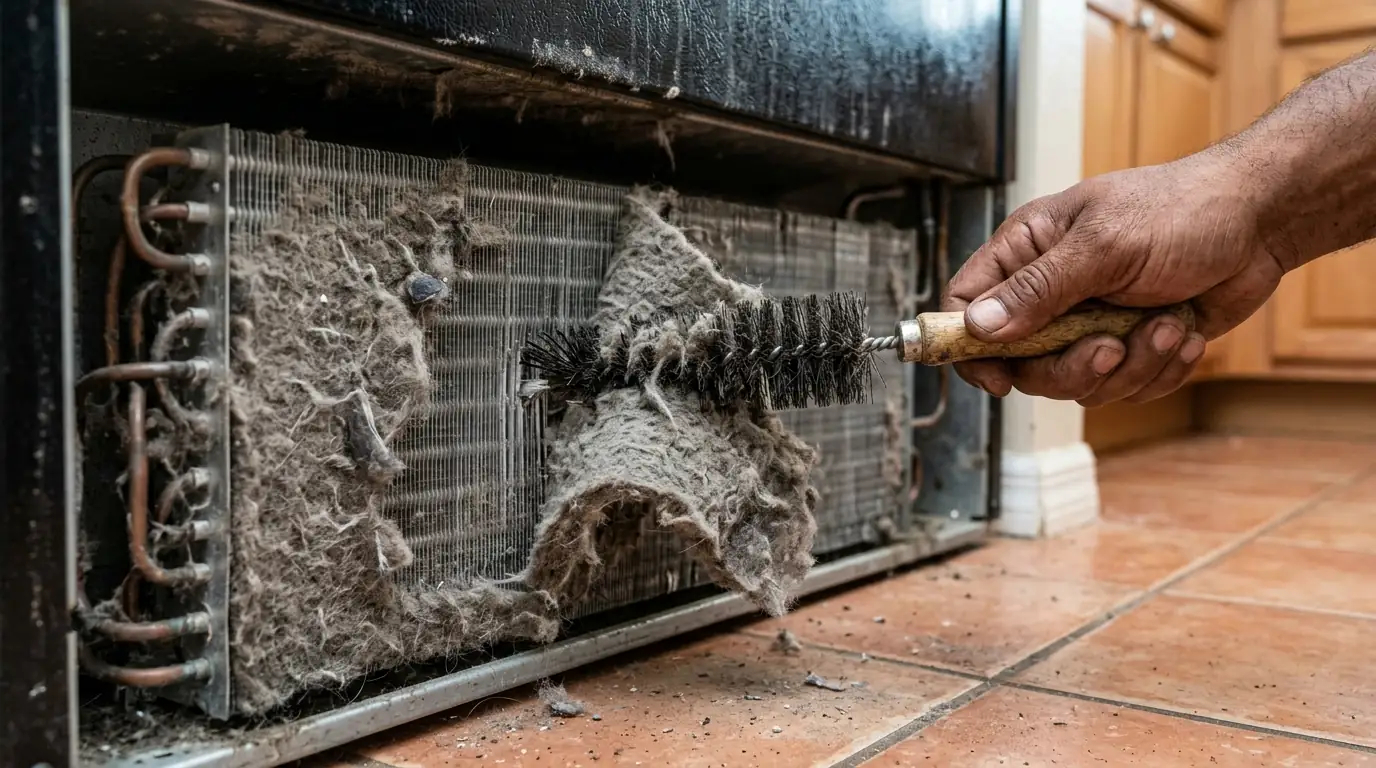
In a humid kitchen it does not. The dust picks up moisture and packs into a felt like mat that clings to the fins. That mat insulates the coil from the air it needs, which is the opposite of what a heat exchanger is for.
Once that happens the machine cannot shed heat properly. It runs longer, gets hotter, and eventually the overload protector starts cutting the compressor out to protect it. Owners describe that as the refrigerator switching itself off, and it is usually a coil that has not been cleaned in six years.
This is why coil cleaning matters more here than the manual suggests. It is not housekeeping, it is the difference between a unit that lasts fifteen years and one that gives up at eight.
The Clearance Problem in Older Kitchens
The second factor is space. A refrigerator wedged into an alcove with an inch either side and a cabinet directly above has very little air to work with, and no amount of cleaning creates air that is not there.
This is common across the older Tampa neighborhoods where kitchens are galley layouts built long before modern appliance sizes. A unit in that position runs almost continuously, which shows on the power bill before it shows on a thermometer.
Where the alcove cannot be changed, keeping the coils genuinely clean becomes more important rather than less, because it is the only remaining lever. Some air at the back and above matters more than clearance at the sides.
Refrigerator running without stopping?
Before assuming the compressor is failing, have the coils and the clearance checked. That is the answer far more often than a major component.
Salt, Garages and the Two Hardest Cases
Near the water, salt reaches the condenser and pits the aluminum fins from the surface inward. Heat transfer drops, the unit runs longer, and corrosion products combine with dust to block airflow further. Two or three cleanings a year genuinely pays on a waterfront property.
Garage refrigerators are the other hard case, and close to a Tampa institution. A second unit in an unconditioned garage spends August trying to hold temperature in air well over 100 degrees. Some models are rated for that and most are not.
When a garage unit fails in July, ambient heat is usually a bigger factor than any single broken part. It is worth knowing that before paying for a repair, because sometimes the honest answer is that the unit is doing everything it can.
What Actually Extends a Refrigerator Here
Clean the condenser coils twice a year with a coil brush and a vacuum, with the unit unplugged. Nothing else on this list comes close in value.
Check the door seal. Close it on a dollar bill and pull. If it slides out easily at any point along the door, the gasket is letting warm humid air in continuously, and in this climate that is a real load.
Leave what clearance you can at the back and above. Do not store anything on top of the unit, because that traps heat against the cabinet.
Clear the defrost drain if you find water under the crisper drawers, and deal with it early rather than after it has warped a drawer.
Signs Your Refrigerator Is Working Too Hard
- The compressor never seems to cycle off
- The kitchen floor near the unit feels warm
- Ice building on the back wall of the freezer
- Water pooling under the crisper drawers
- Condensation forming on the door seal
- Food spoiling faster than it used to
- A clicking sound every few minutes
- The power bill rising with no other explanation
- Coils you cannot remember ever cleaning
Refrigerator Lifespan Questions
Roughly ten to fifteen years with reasonable maintenance, though units in tight alcoves, garages or waterfront properties often land at the lower end. Coil cleaning is what moves a unit up that range.
Twice a year in most Tampa kitchens, and two or three times near the water or in a garage. Annually is the generic advice and it is not enough in this climate.
Yes, with a coil brush and a vacuum and the unit unplugged. On some models the panel does not cooperate, and it is worth having the condenser fan checked at the same time since it has been working against that dust load.
Not if it is rated garage ready. A standard unit out there works beyond its design point for months every year, which shortens compressor life measurably.
Almost always airflow rather than refrigerant. The evaporator fan has failed or the defrost system has stopped clearing the coil, so cold air is not reaching the fresh food section. Both are ordinary repairs.
In this humidity, yes. A tired gasket lets warm moist air in continuously, so the unit never rests. It is also among the cheapest parts on the appliance.
It depends on the part. A fan motor or defrost heater is worth doing. A compressor or sealed system leak on a unit that age usually is not, because the repair approaches half the cost of replacing it.
Services Related to This Guide
Get the refrigerator checked properly
Tell us whether it ever cycles off and when the coils were last cleaned. Those two answers usually point straight at the cause.