Seasonal
Garage Appliances and the Tampa Summer
The second fridge in the garage is close to a Tampa institution. Here is what August does to it, and what to do about that.
The Short Answer
Standard refrigerators and freezers are designed for a room below about 90 degrees. A Tampa garage regularly exceeds 100 for weeks, so a unit out there runs a continuous duty cycle and can still fall behind. Garage ready models handle a much wider ambient range. For a standard unit, shade, clearance, a clean condenser and keeping it full are what buy the extra years.
What Ambient Temperature Actually Does
A refrigerator or freezer works by moving heat out of the box and into the room. The hotter the room, the harder that is, and there is a point past which the unit simply cannot keep up.
Most domestic units are rated for a room below roughly 90 degrees, because that is what a conditioned house provides. A Tampa garage in July and August routinely sits above 100 for weeks at a time.
In that room the unit runs a continuous duty cycle rather than cycling on and off. It may still hold temperature, but every hour of running is wear on the compressor and the fan motors, and on the worst days it can fall behind entirely.
This is why garage units so often appear to fail in high summer and then behave perfectly again in October. Nothing broke. The unit reached its limit and then the limit moved.
What Garage Ready Means
Garage ready is a genuine specification rather than marketing. Those units operate across a much wider ambient range, typically from near freezing to well over 100 degrees.
They also solve a problem in the other direction that catches standard units out. In a cold garage, a standard unit's thermostat can stop calling for cooling because the surrounding air is cool, even though the cabinet inside is warming. Garage ready models handle that.
It is worth checking the specification before buying a unit destined for a garage, because the price difference is usually smaller than the difference in how long it survives out there.
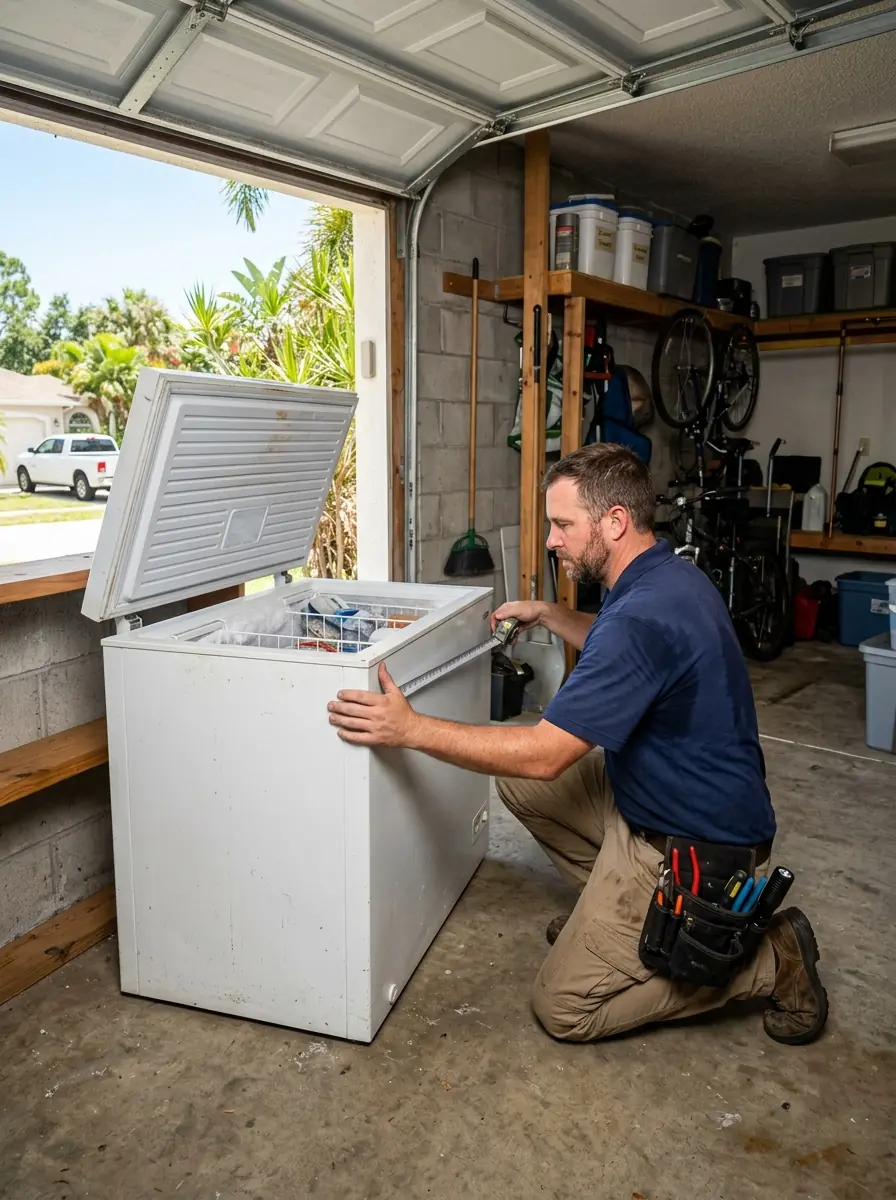
What Helps a Standard Unit Survive
Keep it out of direct sun. A unit sitting where afternoon light comes through a garage window is absorbing heat on top of the ambient load, and moving it a few feet costs nothing.
Leave real clearance around the condenser. Pushing a unit tight against a wall with storage stacked around it removes the air it needs to reject heat into. Some space at the back and above matters most.
Keep the coil genuinely clean. Garage units collect more dust and yard debris than kitchen ones, and a loaded coil compounds exactly the problem the heat is already causing. Twice a year rather than annually is the right interval out there.
Keep it full. A full freezer holds temperature far better than an empty one, because the contents themselves act as thermal mass. Containers of water work perfectly for filling empty space.
Garage unit struggling again this August?
It may be doing everything it can. We will tell you whether the unit is failing or simply being asked too much.
Laundry in the Garage
Washers and dryers in a garage face the same heat with a different result. Mechanically they cope well, because pumps, motors and belts do not particularly mind ambient temperature.
The electronics are what suffer. Control boards are specified for a temperature range, and months above it accelerates the failure of capacitors and solder joints. Dryer thermostats and thermal fuses cycle more because they are regulating heat in a room that is already hot.
That is why the classic garage laundry fault is a machine that is mechanically sound and behaving strangely. An electronic fault in an otherwise healthy machine is exactly what we expect to find out there.
The same advice applies. Shade, air space, nothing stacked on top, and running laundry in the evening rather than mid afternoon through summer. Over years that timing difference is measurable in component life.
The Winter Problem Nobody Expects
Garage appliances have a second failure mode that catches people out in the other direction, and it is worth knowing about because it looks like a fault when it is not.
A standard freezer's thermostat measures the cabinet, but its behavior assumes a room that stays reasonably warm. On a genuinely cool morning, a unit in an unheated garage can stop calling for cooling even though the contents are slowly warming, because the mechanism was never designed for a cold surrounding room.
It rarely reaches a dangerous point in this climate, but it is why some garage units behave inconsistently across the year rather than only in summer. Garage ready models handle both ends of the range, which is the main practical reason to choose one.
If a garage unit behaves oddly in cool weather rather than hot, mention that when you call. It points somewhere quite different from the usual summer diagnosis.
Garage Appliance Checklist for Summer
- Check whether the unit is rated garage ready
- Move it out of any direct afternoon sun
- Leave clearance at the back and above
- Remove storage stacked on top of the cabinet
- Clean the condenser coil twice a year
- Keep freezers full, using water containers if needed
- Check the door or lid seal with a dollar bill
- Run laundry in the evening rather than mid afternoon
- Note the room temperature if a unit starts struggling
Garage Appliance Questions
Ambient heat. Unless it is rated garage ready it was designed for a room below about 90 degrees, and a Tampa garage sits well above that for weeks. It is being asked to do something outside its design.
For a unit destined for a garage here, yes. The price difference is usually smaller than the difference in how long the unit survives out there.
Quite a lot. Shade, clearance around the condenser, nothing stacked on top, a clean coil and keeping the freezer full all reduce the load meaningfully and cost nothing.
The contents act as thermal mass, so the cabinet holds temperature between compressor cycles far better. Containers of water fill empty space perfectly.
That is the classic garage pattern. Pumps, motors and belts do not mind heat, but control boards do, so an electronic fault in a mechanically sound machine is what we expect out there.
Over years, yes. A cycle starting at eight in the evening runs in a garage that has been cooling for hours, rather than at the hottest part of the day.
Twice a year. Garage units collect more dust and yard debris than kitchen ones, and a loaded coil compounds the heat problem.
Services Related to This Guide
Get the garage unit assessed honestly
Tell us where it sits and how hot that space gets. On garage appliances that is half the diagnosis.