Laundry
Dryer Vent Warning Signs You Should Not Ignore
A dryer that runs but will not dry is telling you something specific. Here is how to read it, and why the vent matters more than the machine.
The Short Answer
The clearest sign of a blocked dryer vent is loads needing two or three cycles when they used to need one. Other signs are a hot laundry room, clothes coming out hot but damp, a scorched smell, and thermal fuses that keep blowing. Lint plus heat is the leading cause of laundry fires, so a blocked vent is a safety matter rather than an inconvenience.
What a Dryer Actually Needs to Work
A dryer does three things. It turns the drum, it makes heat, and it carries moisture out of the house. When drying takes longer, at least one of those three has weakened, and the third is the usual answer.
Heat without airflow does not dry clothes. It heats them. That is why the signature symptom of a blocked vent is clothes coming out hot but still damp, which people often read as the machine not getting hot enough when the opposite is true.
Every part of the run matters. The transition duct behind the machine, the main run through a wall or attic, and the exterior hood where the air is supposed to leave. A restriction anywhere reduces the whole system.
The Warning Signs in Order of Seriousness
Loads needing two or three cycles is the first and most reliable sign. If drying takes noticeably longer than it did a year ago and the machine still makes heat, airflow has dropped.
A laundry room that gets hot and humid during a cycle means heat that should be leaving the house is staying in it. That is a straightforward indicator that the air is not getting out.
Repeated thermal fuse failures are the machine protecting itself. The fuse blows because the dryer overheated, and it overheated because the hot air had nowhere to go. Replacing the fuse without clearing the run resets the clock and nothing else.
A burning or scorched smell means stop. That is lint against a heat source and it needs looking at before the machine is used again.
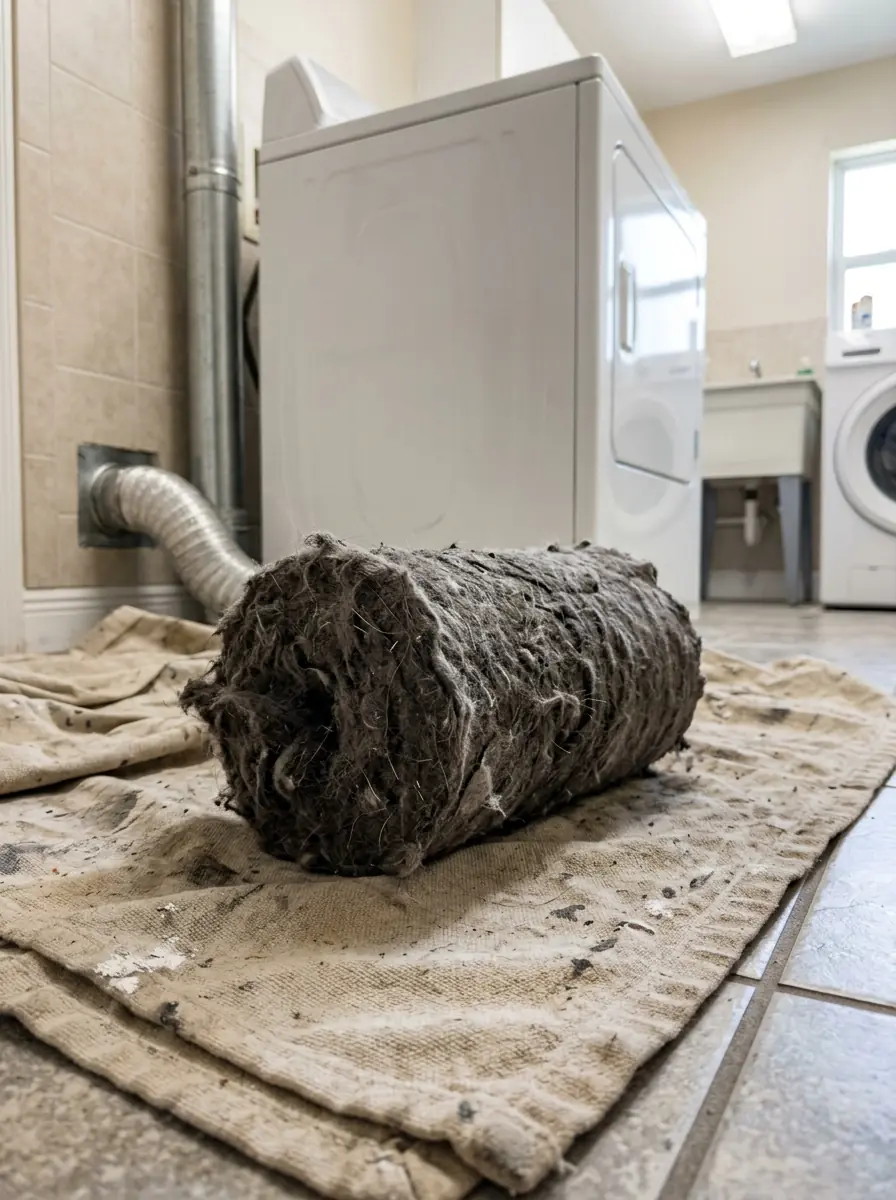
Where the Blockage Usually Is
Rarely where people can reach. The section behind the machine is short, reasonably straight and easy to clear, which is why clearing it alone so often produces disappointing results.
In houses with interior laundry rooms, the run goes through an attic or a wall cavity, and flexible duct sags between supports. Lint settles at the low point, humidity keeps it damp so it compacts rather than blowing clear, and over a few years it becomes a genuine plug.
In older houses with short runs, the duct is often crushed flat behind the machine when it was pushed back into place, or it exits under a low soffit where the air cannot disperse and lint packs at the last elbow.
And occasionally the run does not reach the outside at all. A duct terminating inside a wall cavity is not rare in some housing, and it produces slow drying, a damp structure and lint accumulating where nobody can inspect it.
Two cycles to dry one load?
That is airflow rather than a dying machine. Clearing the full run usually restores drying time the same day.
How to Check It Yourself
Run the dryer on a heat cycle and go outside to the vent hood. You should feel warm moist air moving out of it with real force. Weak flow, or no hood you can find, tells you a great deal.
Check that the damper flap on the hood opens freely and closes when the machine stops. A flap held partly closed by packed lint or corrosion adds resistance permanently.
Pull the machine forward and look at the transition duct. If it is crushed, kinked or made of the thin foil type, replacing it with rigid or semi rigid duct is worth doing.
Clean the lint screen every load, and check the housing below it, which packs with lint the screen does not catch.
Why the Machine Gets Blamed Instead
The reason vent problems go unaddressed for so long is that every symptom points at the dryer. The machine is what you interact with, it is what makes the noise, and it is what stops working.
So people replace a heating element, then a thermostat, then eventually the whole dryer, and the new machine behaves exactly like the old one because the restriction was never in the machine. We see that sequence often enough that it is worth naming.
The test that separates them is straightforward. If the dryer makes heat, and you can feel that heat inside the drum, but clothes still come out damp, the heating side is fine and the airflow side is not. A dryer that makes no heat at all is a different fault entirely and does point at the machine.
Ask any technician who replaces a thermal fuse what made it blow. If the answer does not involve the vent, the same repair will be needed again.
When to Have the Vent Cleared
- Drying takes two cycles when it used to take one
- The laundry room gets hot and humid during a cycle
- Clothes come out hot but still damp
- You cannot feel strong air at the exterior hood
- Lint is visible around the outside vent
- A thermal fuse has blown more than once
- The run goes through an attic and has never been cleared
- It has been more than a year since the last clearing
- There is any burning or scorched smell
Dryer Vent Questions
About once a year for most homes. Sooner if the run goes through an attic, if it is long, or if you dry a lot of towels and bedding, which shed far more lint than clothing.
Yes. Lint is highly combustible and a blocked vent pushes the dryer into repeated overheating. It is the leading cause of laundry fires and it is entirely preventable.
You can clear the transition duct behind the machine, which is worth doing. The sections in a wall or attic are where the real blockages sit and those are not reachable from the laundry room.
Because the cause was not addressed. The fuse blows when the machine overheats, and it overheats because the air cannot leave. Clearing the run is what breaks that cycle.
Yes. Thin foil duct sags and collects lint quickly. Rigid or semi rigid duct stays where it is put and is much easier to keep clear.
Manufacturers publish a maximum equivalent length, typically twenty five to thirty five feet, with each elbow counting as roughly five feet. Long runs with several bends are frequently at or past that.
That needs correcting. It is a moisture and fire issue as well as a drying one, and routing the duct to a proper exterior termination is worth doing once rather than living with it.
Services Related to This Guide
Book a vent clearing
Tell us where the dryer sits and roughly where the duct exits. That tells us how long the run is likely to be.